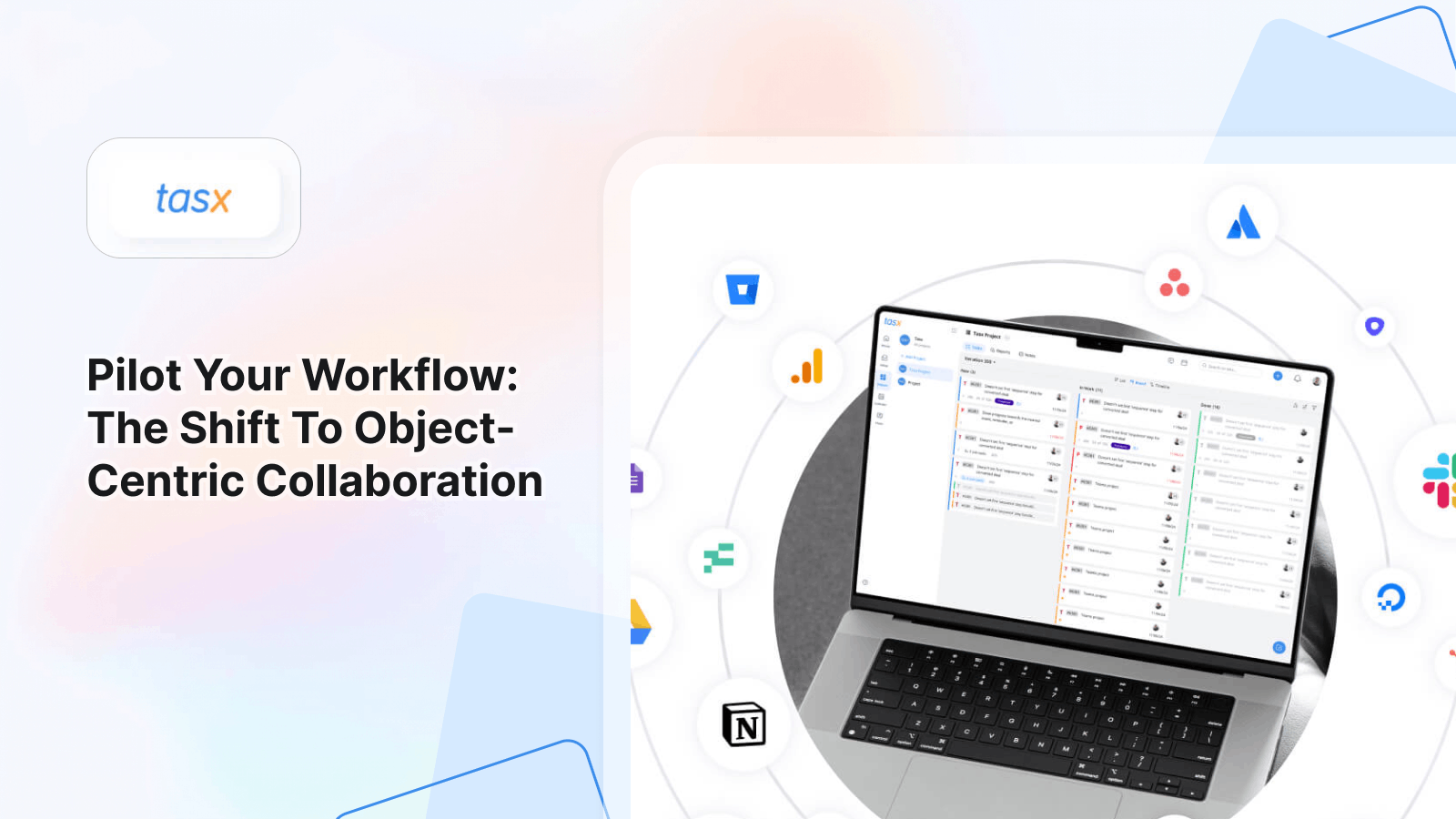
If you look closely at how modern businesses operate, you will notice an uncomfortable truth: most teams are not actively steering their operations. Instead, they are just trying to keep the plane in the air.
Think about your daily routine. You likely start your morning by checking an overflowing email inbox. Then, you switch to a company-wide chat application to decipher a barrage of unread messages. From there, you open a separate project management board to move a few digital cards around, only to realize you need to log into an entirely different CRM platform to verify a client’s status.
When your daily operations involve frantically jumping between a disconnected CRM, a chaotic chat application, and rigid task boards, you are not flying. You are fighting turbulence. Context gets lost, communication breaks down, and talented professionals end up spending more time managing their software stack than executing their actual work.
At Tasx, we realized that the software industry’s standard answer to this problem—the traditional dashboard—was fundamentally flawed. We did not just want to build another dashboard that displays data from disconnected sources. We wanted to rebuild the cockpit from the ground up.
It is time to move beyond passively managing your tasks. It is time to pilot your workflow.
The Illusion of the Traditional Dashboard
For the better part of a decade, business software providers have been selling companies on a singular dream: the unified dashboard. The promise was incredibly appealing. If you simply put your project metrics, CRM pipeline, and team chat onto one single screen, your productivity bottlenecks would instantly disappear.
But as companies scaled and workflows became more complex, the cracks in this model became impossible to ignore.
Traditional platforms did not actually break down operational silos; they merely placed those silos next to each other. Your team chat was still functionally separated from your task lists. Your CRM data was still structurally disconnected from your active project boards. You did not have to open a new browser tab, but you still had to navigate through five different internal modules just to complete a single workflow.
This creates a heavy cognitive load. Every time an employee has to stop looking at a project board to go search for a corresponding conversation in a chat channel, it takes an average of twenty minutes to regain their original focus. To truly fix how teams collaborate, we had to rethink the foundational architecture of business software. We had to stop thinking about isolated applications and start thinking about the actual work.
The Paradigm Shift: Object-Centric Collaboration
To pilot a workflow effectively, a team needs absolute clarity and zero operational friction. At Tasx, we achieve this by moving away from fragmented application modules and introducing a revolutionary concept: Object-Centric Collaboration.
In legacy platforms, work is scattered. You have a chat section, a tasks section, and a customer section. In Tasx, everything you and your team work on is treated as an independent, living entity known as an Object.
A high-value client in your CRM is an object. A specific quarterly marketing campaign is an object. A software bug ticket, a financial invoice, or a creative design asset—they are all distinct objects.
Instead of moving these items through disparate, rigid systems, your team collaborates directly on and inside the object itself. The object becomes a centralized ecosystem that holds everything related to that specific piece of work: the data, the files, the history, the communication, and the artificial intelligence.
| Traditional Workspace Architecture | Tasx Object-Centric Architecture |
|---|---|
| Work is separated by software category (e.g., all chats in one app, all files in another). | Work is unified by the subject matter (e.g., the chat and files live inside the task). |
| Requires manual linking between platforms. | Objects naturally connect to each other within the same ecosystem. |
| Context is frequently lost during handoffs. | Complete historical context remains permanently attached to the object. |
Clear Communication: Dedicated Chat for Every Object
Nothing causes a workflow to crash faster than miscommunication and lost context.
We have all experienced the nightmare of the endless chat channel. You need an update on a specific client account, so you scroll through hundreds of messages in a general sales channel, trying to piece together a conversation that happened three days ago between four different people. It is the equivalent of flying blind.
Tasx solves this by attaching the conversation directly to the work. Every single object in Tasx has its own dedicated chat environment.
If you need to discuss a specific client deal, you do not go to a general sales channel; you talk inside the specific Deal Object. If you need feedback on a landing page design, you message your team inside that specific Design Object.
The benefits of object-level chat are immediate. The conversation is permanently attached to the work, meaning you never have to ask your colleagues which project they are referring to. When a new team member joins a project mid-way, they do not need a lengthy briefing meeting. They simply open the object and read the chat history to see exactly how the project evolved. Furthermore, you only receive notifications for the objects you are actively involved in, eliminating the constant noise of company-wide channels.
Your Intelligent Co-Pilot: Context-Aware AI
Every great pilot relies on a great co-pilot to handle complex calculations and monitor critical systems. But in the current landscape of business software, most artificial intelligence integrations fall completely flat.
A standard AI chatbot is only as useful as the context you manually feed it. If you have to spend ten minutes writing a massive text prompt to explain the background of a project to an AI, you have not saved any time.
Because Tasx is built on an object-centric foundation, we were able to integrate AI directly into every single object’s chat environment. Your AI assistant does not live in a separate browser window; it lives inside the work alongside your team, securely reading the exact same data and chat history that you do.
You do not have to explain the background because the AI already knows. You can simply open an object and ask your AI co-pilot to execute complex tasks instantly. Whether you need a quick summary of the last two days of client feedback, a professional status report drafted directly from the object’s entire chat history, or an analysis of potential bottlenecks based on the current team conversation, the AI is ready to deliver.
The AI handles the heavy lifting, the summarization, and the data processing. This frees your human team to focus on high-level strategy, creative problem-solving, and decisive execution.
The Freedom to Code Your Edge
With all this talk about artificial intelligence and automation, we want to address a common myth in the technology industry: the promise of a completely no-code platform.
We do not claim to be a magical black box that completely replaces human engineering. Pure no-code tools are fantastic for basic automation, but the moment you need a custom API integration or a highly unique algorithmic strategy, those platforms lock you out. You end up trapped in a sandbox, unable to execute your competitive advantage.
Tasx was built by a team of real, passionate developers who understand the need for flexibility. Our AI acts as a powerful accelerator, designed to handle the friction of standard API connections, data structuring, and boilerplate code. It does the heavy lifting in seconds, drastically reducing your setup time.
However, we leave the door wide open for your team to code. Once the AI sets up the infrastructure, you maintain total freedom to dive into the codebase. You can write custom scripts, experiment with unique logic, and tweak your strategies exactly the way your business requires. You get the rapid deployment speed of AI alongside the limitless flexibility of custom development.
Take Control of Your Work Today
The future of productivity is not about paying for more software subscriptions that refuse to communicate with one another. It is about bringing your tools, your team, and your artificial intelligence directly to the work itself.
By transitioning to an object-centric workspace, Tasx eliminates context switching, permanently attaches crucial communication to your work, and unleashes the true potential of contextual AI. It gives you the visibility, the speed, and the control you need to steer your business toward its goals.
It is time to stop fighting turbulence. It is time to start flying.
We are finalizing the platform for our official launch this September. If you are ready to take the controls and experience a truly unified workspace, explore our features and secure your early access at tasx.com.